
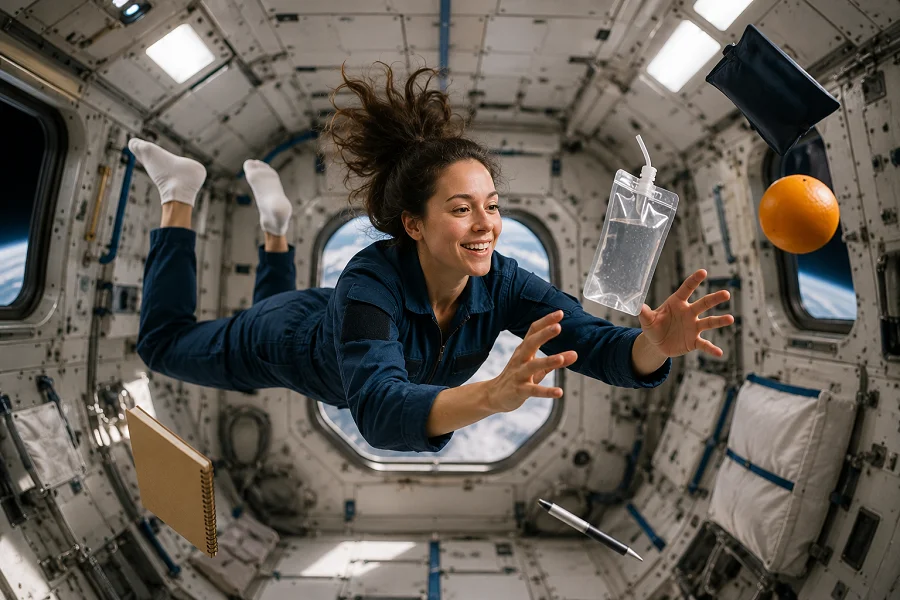
Floating weightlessly through a spacecraft looks effortless and almost magical in footage from orbit, but the reality for the human body is considerably more complicated. Zero gravity, more precisely called microgravity, removes a force that every system in the human body has spent millions of years adapting to rely on. From the earliest Soviet cosmonauts to the long-duration crews who lived aboard Mir, decades of spaceflight have revealed just how profoundly the absence of gravity reshapes human physiology. This article looks at what actually happens to the body in zero gravity, and why understanding these effects has been so central to the history of long-duration space stations.
What zero gravity actually means
True zero gravity does not really exist anywhere reachable by current spacecraft, since gravity technically extends throughout the universe. What astronauts experience aboard a space station is more accurately called microgravity, a state of continuous free-fall around the Earth that creates the sensation of weightlessness. The force of gravity holds objects on the ground and keeps planets in orbit, and a very weak version of that same pull is what defines the microgravity environment aboard stations like Mir and the ISS.
The first few days: space adaptation syndrome
Almost every astronaut experiences some version of the same rough introduction to weightlessness. For the first few days in orbit, many crew members feel a kind of travel sickness that NASA has termed Space Adaptation Syndrome. This occurs because the body relies heavily on gravity to determine which way is up, and without that reference point, the inner ear and brain send conflicting signals that can produce genuine nausea and disorientation until the body begins adapting to its new environment.
Muscles: the cost of not having to work
On Earth, muscles are engaged constantly just to keep the body upright and moving against gravity’s pull. In microgravity, that mechanical load essentially disappears, and the muscles respond by weakening rapidly. Astronauts on long-duration missions can lose up to thirty percent of their muscle mass, with the effect most pronounced in the legs, back and neck, the muscles that normally do the most work supporting the body against gravity. This is precisely why long-duration crews, from Mir’s cosmonauts onward, have always followed rigorous daily exercise routines using specialised resistance equipment designed to simulate the load that gravity would otherwise provide.
Bones: a slower but serious decline
Bone loss follows a similarly troubling pattern, though it unfolds more gradually than muscle atrophy. Without the constant mechanical stimulation that gravity normally provides, astronauts can lose one to two percent of their bone mass per month in orbit, with total losses reaching up to ten percent of bone density over a six-month mission. Recovering this lost bone density after returning to Earth can take years, and the increased fracture risk during that recovery period is one of the most persistent medical concerns in long-duration spaceflight planning.
The cardiovascular system adapts too
The heart and circulatory system evolve specifically to pump blood against Earth’s gravity, and this entire system has to readjust once that resistance disappears. Fluids shift upward in the body in microgravity, causing the face and upper body to swell while the legs become noticeably thinner, an effect astronauts sometimes describe as looking almost unrecognisable in photographs from orbit. This same fluid shift also affects the inner ear and vision, and contributes to the persistent nasal congestion many astronauts report throughout their missions.
A surprising side effect: growing taller
One of the more unexpected effects of zero gravity is genuinely pleasant, at least temporarily. Without Earth’s gravity compressing the spine throughout the day, astronauts’ bodies relax and stretch out, and crew members can gain up to two inches in height during extended missions. This growth spurt is entirely temporary, however, and reverses as soon as gravity compresses the spine back to its normal length upon return to Earth.
Blood and the immune system
Microgravity also interferes with the body’s production of red blood cells, a condition researchers have nicknamed space anemia. Alongside this, extended time in orbit has been shown to disrupt immune function, making the body’s defences less reliable exactly when astronauts are also facing higher exposure to ionising radiation than they would on Earth’s surface. Research continues into exactly how these combined stressors interact over the kind of extended mission durations that stations like Mir helped pioneer.
What Mir’s long-duration missions taught researchers
Long before the International Space Station existed, Mir’s crews were already living through many of these same physiological changes during missions that, in some cases, stretched beyond a year in orbit. The data gathered from cosmonauts aboard Mir Space Station during these extended stays became genuinely foundational to how space agencies understood the cumulative, long-term effects of microgravity, informing the exercise protocols, dietary planning and medical monitoring that every subsequent long-duration space station has built upon.
The brain and cognition in microgravity
Beyond the well-documented effects on muscles and bones, researchers have increasingly turned their attention to how zero gravity affects the brain itself. Changes in the vestibular system, the inner ear structures responsible for balance, alter how the brain processes spatial information in orbit, sometimes producing lasting neurovestibular effects that persist even after astronauts return to Earth. This remains one of the more active areas of ongoing space medicine research, since a full understanding of cognitive changes in microgravity matters enormously for future missions that will keep crews in space for even longer periods than Mir or the ISS ever managed.
Why fire and water behave differently too
Zero gravity does not only reshape human physiology, it changes basic physical behaviour throughout a spacecraft in ways that are genuinely fascinating to observe. Flames burn in a spherical shape rather than the familiar teardrop form they take on Earth, since there is no upward convection current to stretch them. Water forms perfect floating spheres rather than pooling or flowing, and even structures built by small creatures like spiders change shape when built in microgravity, offering researchers an unusual but genuinely useful window into how fundamental physical processes actually work.
Countermeasures developed through decades of experience
Every one of these physiological challenges has driven the development of specific countermeasures that have been refined across decades of long-duration missions. Daily resistance and cardiovascular exercise, carefully monitored nutrition, and structured rehabilitation protocols upon return to Earth all trace their origins back to hard-won lessons from early long-duration missions, where crews and mission planners were often learning the real risks of extended weightlessness for the first time as they went.
Conclusion
Zero gravity is far from the effortless, weightless novelty it appears to be in footage from orbit. From rapid muscle and bone loss to fluid shifts, immune changes and genuine questions about long-term cognitive effects, microgravity challenges nearly every system in the human body. The decades of data gathered from long-duration missions, including the pioneering years spent aboard Mir, remain essential to understanding these effects and preparing for the even longer missions that future space exploration will demand.