
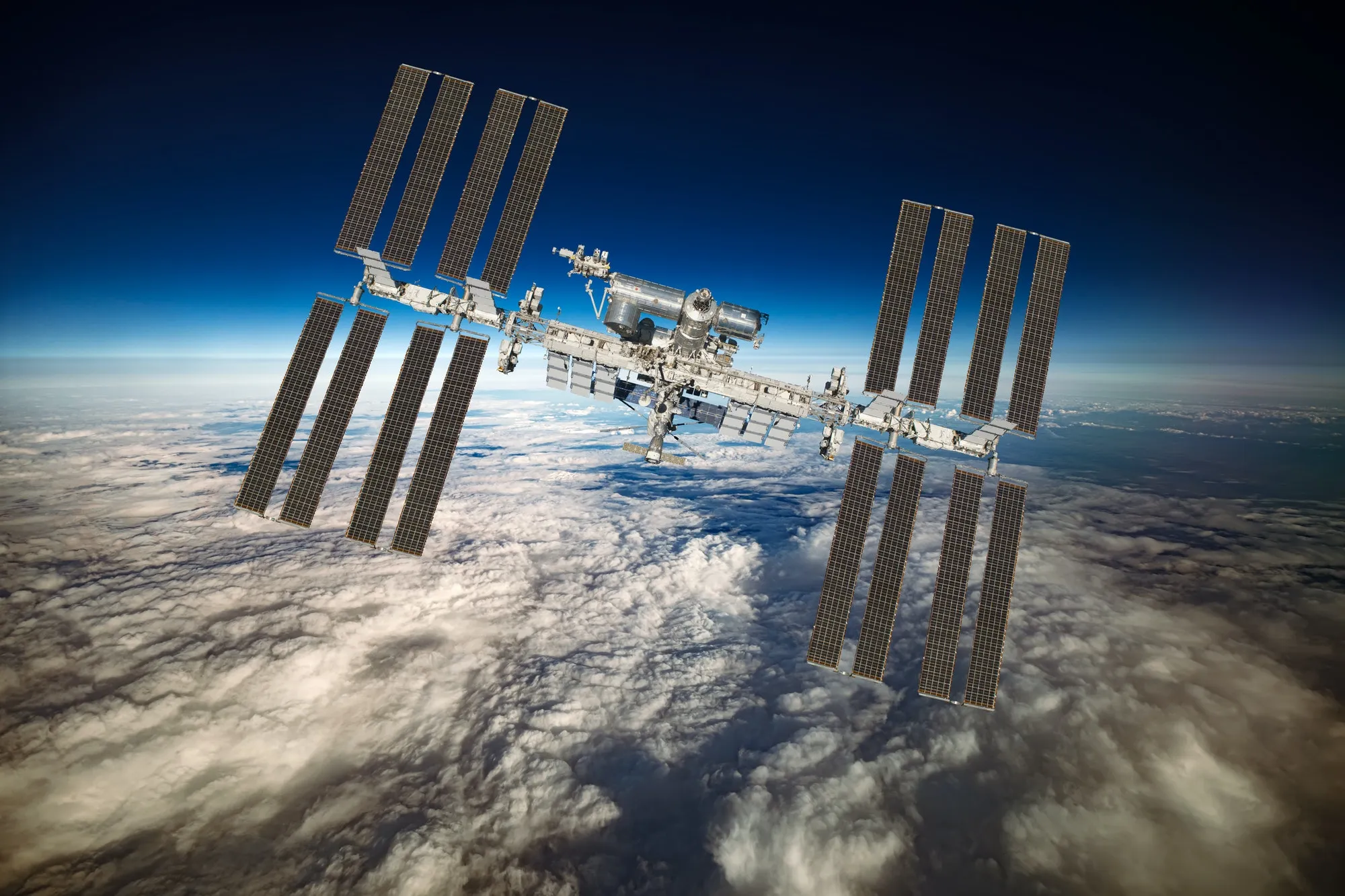
Every space station eventually comes to the end of its working life. Hardware ages, budgets move on to new projects, and keeping an old station safe becomes harder each year. At that point the people running it face a problem that has nothing to do with science and everything to do with physics: how do you bring a structure weighing many tonnes back out of orbit without putting anyone on the ground at risk? Mir's final descent in 2001 is still one of the best examples of how it can be done, and the same questions now apply to the International Space Station.
Why stations cannot stay up forever
Space stations orbit in low Earth orbit, only a few hundred kilometres above the surface. At that height there is still a very thin trace of atmosphere, and it creates a small but constant drag. Over time this slows the station down and lowers its orbit. To stay up, a station has to be boosted regularly, either with its own engines or with the engines of visiting cargo ships.
Once those boosts stop, the orbit decays. The station sinks lower, drag increases and eventually it falls into the denser atmosphere. Much of it burns up on the way down, but large and heavy parts such as engines, tanks and structural frames can survive and reach the surface. With a station the size of Mir, simply letting it fall wherever it happened to come down was not a responsible option.
Lessons from uncontrolled re-entries
Earlier stations showed what can happen when there is no control over the descent. Skylab, the first American space station, re-entered in July 1979 earlier than planned, partly because of higher solar activity that thickened the upper atmosphere. Debris landed across a sparsely populated part of Western Australia. Nobody was hurt, but it caused worldwide attention and some nervous moments. You can read more about Skylab on our US Space Station page.
The Soviet station Salyut 7 also came down without full control in 1991, with pieces falling over Argentina. Again there were no injuries, but both cases made clear that a much larger station needed a planned, guided ending.
Mir's final plunge
By the late 1990s Mir had far outlived its planned five-year life, and Russia was committing its resources to the new International Space Station. The decision was made to bring Mir down in a controlled way. A specially prepared Progress cargo ship docked with the station and carried extra fuel for the job.
On 23 March 2001 the Progress engines fired in a series of burns that lowered the orbit and then sent Mir steeply into the atmosphere. The aim was to drop any surviving debris into a remote stretch of the South Pacific, far from shipping lanes and populated islands. The re-entry went to plan, and people in Fiji reported seeing glowing fragments streak across the sky as the station broke apart. After fifteen years in orbit, Mir's story ended in a few minutes. For more on the station's long career, see our article on Mir as the space station Silicon Valley.
The spacecraft cemetery
The area chosen for controlled re-entries is often called the spacecraft cemetery. It lies around Point Nemo, the place in the ocean that is furthest from any land, more than 2,500 kilometres from the nearest coast. Space agencies have used this region for many years to dispose of cargo ships, old satellites and other large objects, because it gives the widest possible safety margin if pieces survive the fall.
Aiming for such a spot takes careful planning. The final engine burns have to happen at exactly the right point in the orbit, and the debris footprint can stretch for many hundreds of kilometres along the flight path. That is why controlled re-entries of large objects are planned months or even years in advance.
How the ISS is expected to end
The International Space Station is much larger than Mir, and its partners currently plan to operate it until around 2030. Bringing it down safely is an even bigger engineering task. NASA has chosen SpaceX to build a dedicated deorbit vehicle that will attach to the station near the end of its life and provide the push needed to guide it into the ocean, much as Progress did for Mir, only on a far larger scale.
At the same time, several companies and space agencies are working on new stations to take over from the ISS. If those plans go ahead, the end of the ISS will be less of a full stop and more of a handover, similar to how Mir's retirement made way for the ISS itself.
Conclusion
The end of a space station is a carefully planned event rather than an accident waiting to happen. Skylab and Salyut 7 showed the risks of losing control, while Mir proved that a large station could be guided safely into the ocean. That experience is now shaping how the ISS will be retired, and how future stations will be designed with their own final journey in mind.